
When you find out you’re expecting, you probably want to know: What week should you do a gender reveal? The short answer is that most parents wait until the routine second-trimester ultrasound – around 18–20 weeks – because this is when the baby’s sex organs are developed enough to see clearly. During the standard anatomy scan (roughly 18–22 weeks), technicians can usually spot the baby’s genitalia, with accuracy often above 90–95%. However, if you’re eager to know sooner, special blood tests can work much earlier (see below). In a nutshell: an anatomy-scan gender reveal around 20 weeks is most common, but advanced tests like NIPT or at-home DNA kits can reveal gender by 6–10 weeks if you prefer an early answer.
Early Blood Tests (6–10 Weeks)
Some expectant parents opt for a blood test to learn gender long before the anatomy scan. Non-Invasive Prenatal Testing (NIPT), which is usually done around 10 weeks, can also reveal sex. In fact, one lab points out that their prenatal gender DNA test works from 6 weeks of pregnancy with ~99.9% accuracy. At-home kits like SneakPeek claim similar accuracy starting at 6–7 weeks. These blood-based methods are very accurate, but they require ordering a kit or scheduling a lab draw and waiting a week or two for results. If you go this route, plan your reveal party a few weeks after getting the result (for example, a test at 10 weeks might mean a reveal party around 12–14 weeks once you have the answer).
- Pros: Earliest possible results (as early as 6–10 weeks) and very high accuracy.
- Cons: Usually costs more, requires waiting for lab results, and must be done privately (you won’t get the result at a routine doctor visit).
Ultrasound Timing (Early vs. Routine)
Ultrasound is the traditional way to find out gender. Some clinics offer early elective scans (around 11–13 weeks) that attempt to guess gender (often called the “nub theory”). This method can be fun, but it’s far less reliable – studies show about only 75–80% accuracy in the late first trimester. In other words, only about 3 out of 4 guesses at 11–13 weeks are correct. Because of this, most experts don’t trust early scans alone to confirm gender.
By 18–22 weeks (second trimester), however, the baby’s anatomy is usually clear. The routine 20-week anatomy scan often can reveal your baby’s sex. For example, Cleveland Clinic notes that this mid-pregnancy scan (around 20 weeks) is when parents can typically learn the fetus’s sex. Accuracy at this point is very high – in one study nearly 100% of ultrasounds after 14 weeks were correct about gender. Still, even at 18–22 weeks there’s a small chance (around 5–10%) of error, often due to the baby’s position or interpretation mistakes.
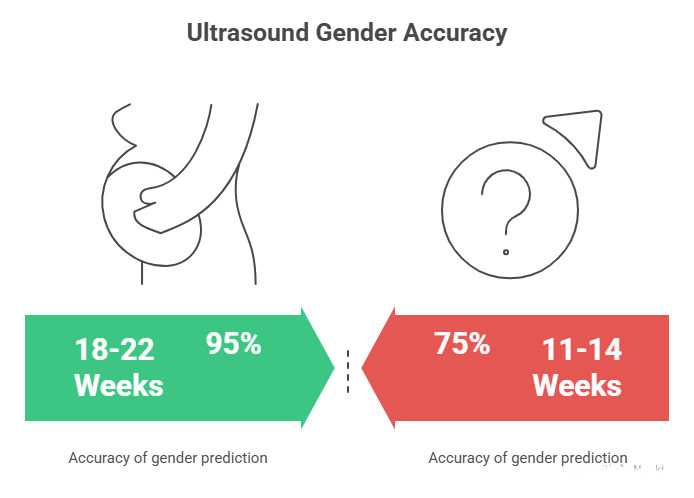
- 18–22 weeks (Anatomy Scan): This is the most reliable window. Most OB providers check fetal sex during the anatomy scan (18–22 weeks), with accuracy often quoted around 90–95%.
- Early scan (~11–14 weeks): This “nub theory” or dating scan can sometimes predict gender, but it’s only about 75–80% accurate. Treat it as a tentative guess rather than a sure answer.
- Technical factors: Ultrasound accuracy improves later in pregnancy. If the baby’s legs are crossed or curled, the tech may miss the genitals. An experienced sonographer is more likely to make the call correctly.
Planning Your Gender Reveal Party
Once you know the gender (or have a good guess), you’ll pick a week to celebrate. Many first-time parents choose the late second trimester for their gender reveal party. For example, one mom waited until about 20 weeks – she was feeling better and still active – and found it perfect timing. In fact, many couples plan their reveal between 16–22 weeks of pregnancy. This gives them time to be confident in the result and still leaves plenty of pregnancy months ahead.
- Confirm the result first. Wait for an official scan (usually after 18 weeks) to be sure before announcing.
- Reveal the news before your belly gets too big or before a baby shower. Many guides suggest finishing your reveal by the time you’d normally have a third-trimester shower.
- Plan ahead. A party around 16–22 weeks gives you time to send invites, order colored cakes or confetti, and make the day special.
Some parents combine the gender reveal and baby shower, but others keep them separate to fully enjoy each event. Choose a date that works with your (and your guests’) schedules and when you feel your best – maybe a sunny weekend for an outdoor reveal or a cozy indoor cake-cutting. As one mom put it: the best week is when it “feels doable, joyful, and like something you’ll look back on with a smile”.
Conclusion
There’s no single “right” week – it depends on how you choose to find out your baby’s sex. If you want maximum accuracy, wait until 18–20 weeks for the routine anatomy ultrasound. If you’re very eager, early blood tests can tell you by 6–10 weeks, but you’d still plan the reveal event later. Many parents find that scheduling a gender reveal party in the 16–22 week range works best: it lets you double-check the gender and then celebrate while mom still feels relatively energetic. Always consider your personal health, comfort, and calendar. Talk with your doctor or midwife – in the end, the “best week” is what makes sense for your pregnancy and lets you enjoy this special milestone with confidence and joy. Ready to find out your baby’s gender? Schedule your ultrasound with Look At Me 4D Imaging today.